
 WhatsApp
Thirteen years after the enactment of the Sexual Harassment of Women at Workplace (Prevention, Prohibition and Redressal) Act, 2013 (the PoSH Act)—and nearly three decades since the Supreme Court outlined the Vishaka Guidelines—Indian workplaces find themselves at an institutional crossroads.
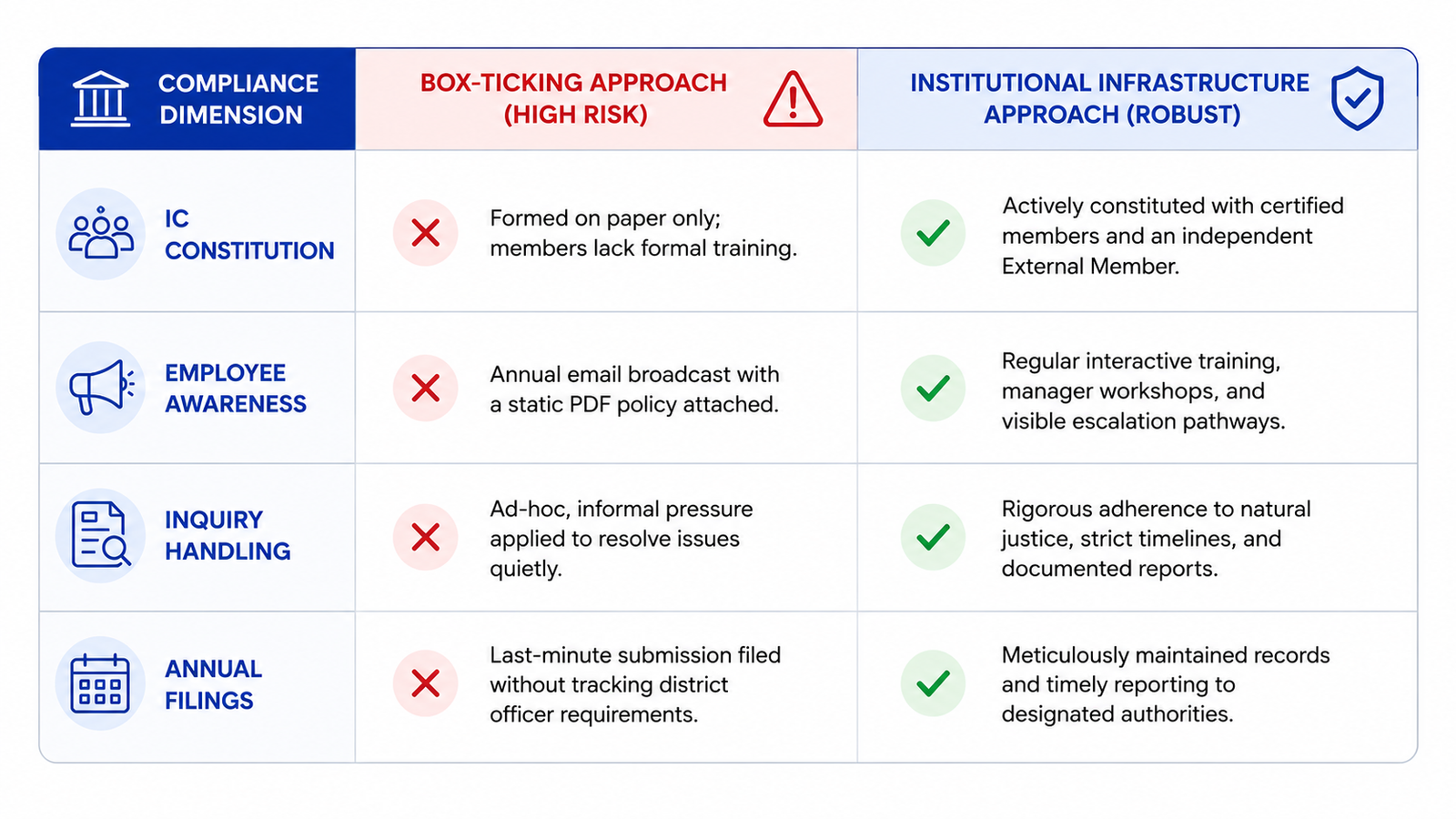
Walk into most corporate offices across Bengaluru, Mumbai, or Gurugram, and you will find a Prevention of Sexual Harassment policy neatly uploaded to the employee intranet, an Internal Committee (IC) chart displayed on a notice board, and annual returns filed like clockwork. Yet, recurring workplace incidents and systemic trust deficits reveal an uncomfortable truth: having a policy on paper is entirely different from cultivating a safe working environment.
When corporate compliance is reduced to an administrative checklist, the true purpose of the legislation is lost. To bridge the gap between regulatory mandates and daily corporate reality, employers, HR leaders, and business owners must examine why traditional compliance frameworks so often fail—and how to fix them.
The Anatomy of "Decoupling": Form Versus Function
In organizational compliance, a phenomenon known as decoupling frequently occurs. This happens when an enterprise maintains an elaborate structural facade—such as a polished PoSH policy and a formally constituted IC—while its actual daily culture, informal communication channels, and power hierarchies operate entirely independently of those rules.
Decoupling typically manifests in three distinct ways:
- The Compliance Facade: The company treats PoSH training as a 15-minute digital slideshow completed during onboarding, ticking a box rather than driving true comprehension.
- The Silence Penalty: Employees quickly realize that reporting subtle boundary violations or microaggressions carries professional risks, leading to a culture of informal endurance.
- The Reputation Shield: Internal Committees occasionally view their primary objective as protecting the company's brand image or shielding senior management, rather than conducting objective, impartial fact-finding inquiries.
When compliance is treated as a shield against legal liability rather than a core component of organizational health, the safety net collapses the moment a real crisis occurs.
The Economic and Cultural Limits of Minimalist Compliance
A rigorous assessment of workplace safety must account for the incentives driving corporate behavior. Under Section 26 of the PoSH Act, 2013, an employer who fails to constitute an IC or violates other core provisions faces a statutory fine of up to ₹50,000.
For many mid-to-large enterprises, a ₹50,000 penalty functions more like an administrative fee than a true financial deterrent. When the operational cost of deep compliance—such as comprehensive training, independent investigations, and expert advisory support—outweighs the expected cost of enforcement, under-investment becomes a predictable corporate shortcut.
However, financial penalties represent only a fraction of the actual exposure. The broader costs of superficial compliance include:
- Severe Reputational Fallout: Public scrutiny of mishandled grievances can erode employer branding and client trust overnight.
- Talent Attrition: Modern professionals increasingly evaluate prospective employers based on psychological safety and corporate ethics.
- Litigation and Writ Petitions: Flawed inquiries and procedural lapses frequently end up before High Courts, leading to costly legal battles, public embarrassment, and strict judicial reprimands.
Balancing Rigor, Natural Justice, and Psychological Safety
A credible PoSH framework must achieve a delicate balance: protecting the genuinely aggrieved while meticulously safeguarding the rights of the accused against arbitrary action or malicious intent.
Public trust erodes when either extreme occurs—whether legitimate complaints are trivialized or buried, or when the inquiry process disregards principles of natural justice.
- The Mandate of Section 14: The PoSH Act includes explicit provisions to penalize malicious complaints or false evidence. However, organizations often fail to apply these safeguards consistently, leaving wrongly accused employees facing reputational limbo even when cleared by an exhaustive inquiry.
- Procedural Integrity: An IC must operate with absolute adherence to procedural fairness—providing adequate notice, maintaining strict confidentiality, sharing documentation equitably, and avoiding pre-judgments. Natural justice is not an obstacle to safety; it is the absolute precondition for the legal validity of any inquiry.
Practical Roadmap: Moving from Paperwork to Real Safety
Transforming an organization's PoSH framework from a liability shield into an active safety infrastructure requires deliberate, strategic interventions.
1. Rebuild the Internal Committee
Ensure the Presiding Officer and IC members undergo comprehensive, professional training covering trauma-informed interviewing and natural justice. Appoint an active, experienced External Member who can provide independent perspective and guide complex inquiries objectively.
2. Cultivate Psychological Safety
Shift employee awareness messaging away from fear-based legal warnings toward transparent, accessible channels of resolution. Ensure middle and senior managers—who often act as the first line of escalation—are trained to handle disclosures without minimizing or informally brushing them aside.
Frequently Asked Questions (FAQs) :
What are the legal consequences of not constituting an Internal Committee?
Under Section 26 of the PoSH Act, 2013, an employer who fails to constitute an IC or violates other provisions faces a penalty of up to ₹50,000. Subsequent violations can attract double the penalty, cancellation of business licenses, or withdrawal of statutory registrations.
Can an organization manage a PoSH complaint without an External Member?
No. Section 4 of the PoSH Act explicitly mandates the inclusion of an External Member—typically someone familiar with social work or legal issues relating to sexual harassment—to ensure independence and prevent internal corporate bias during inquiries.
How frequently should employee awareness training be conducted?
While the statute mandates periodic orientation, best practices dictate conducting awareness sessions for all employees annually, alongside specialized training modules for managers and mandatory orientation for newly onboarded staff.
Strengthen Your Workplace Compliance Framework:
Moving beyond basic paperwork requires expert guidance, robust policy structures, and continuous committee training. Whether you need help with Internal Committee formation, External Member support, or comprehensive employee awareness training, Poshaw provides end-to-end solutions tailored to your organization.
- Email: info@poshaw.in
- Phone: +91 9773831359 / +91 9999415757
- Website: https://poshaw.in/