
 WhatsApp
When the Sexual Harassment of Women at Workplace (Prevention, Prohibition and Redressal) Act, 2013 (PoSH Act) was enacted, its primary objective was to create a safe, secure, and harassment-free working environment specifically for women. However, as modern workplaces evolve toward greater diversity, equity, and inclusion, HR leaders and Internal Committees (ICs) frequently confront a critical legal question: Does the PoSH Act protect transgender women?
Because Section 2(a) of the PoSH Act specifically defines an "aggrieved woman" using binary, gender-specific language, organizations often grapple with statutory ambiguity when handling complaints from transgender women, trans men, or non-binary employees.
Understanding how Indian constitutional law, judicial rulings, and the Transgender Persons (Protection of Rights) Act, 2019 intersect with the PoSH Act is essential for building a legally compliant and inclusive workplace.
The Statutory Gap: Binary Framing in the PoSH Act (2013)
Under Section 2(a) of the PoSH Act, an aggrieved woman is defined as any woman—regardless of age, employment status, or nature of work—who alleges to have been subjected to sexual harassment at a workplace.
When Parliament drafted the statute in 2013, the legislative focus was primarily cisgender-centric. As a result:
- No Explicit Mention of Transgender Individuals: The Act does not explicitly define or address gender identity, trans women, trans men, or gender-nonconforming individuals.
- Jurisdictional Questions for Internal Committees: Internal Committees often hesitate when receiving complaints from transgender employees, questioning whether they hold the statutory mandate to investigate under PoSH rules.
Despite this statutory gap, legal standards in India have shifted significantly through landmark judicial decisions and secondary legislation.
Landmark Judicial Precedents & Legal Context
Indian courts have consistently interpreted statutes protecting women through a progressive, constitutional lens to ensure equal protection under the law.
1. NALSA v. Union of India (2014)
The Supreme Court of India recognized self-perceived gender identity as an intrinsic part of human dignity under Articles 14, 15, and 21 of the Constitution. The Court affirmed that transgender individuals have the right to self-identify as male, female, or third gender.
- Legal Implication: A transgender woman who self-identifies as a woman is entitled to the same legal rights and statutory protections afforded to any woman under Indian law.
2. Judicial Harmonization Under Section 354A IPC
In criminal jurisprudence, courts have held that provisions penalizing sexual harassment against women apply equally to transgender women. By extension, Internal Committees must adopt a purposive interpretation of the PoSH Act—treating a complaint by a transgender woman with the same gravity and statutory protocol as any other female employee.
Interplay Between the PoSH Act and the Transgender Persons Act (2019)
Employers must look beyond the PoSH Act to satisfy their full legal obligations. The Transgender Persons (Protection of Rights) Act, 2019 establishes mandatory workplace compliance requirements:
- Prohibition of Workplace Discrimination (Section 3): Employers cannot discriminate against transgender individuals in recruitment, promotion, employment conditions, or workplace facilities.
- Mandatory Equal Opportunity Policy: Organizations must formulate, publish, and implement a dedicated Equal Opportunity Policy catering to transgender employees.
- Designated Complaint Officer: Employers are legally required to appoint a specific Complaint Officer to investigate grievances regarding discrimination or harassment faced by transgender personnel.
Framework: Navigating Protection Gaps in Workplace Harassment
While transgender women are protected under an inclusive reading of the PoSH Act, statutory gaps remain for trans men and non-binary staff. The following framework outlines how organizations can bridge these compliance gaps:
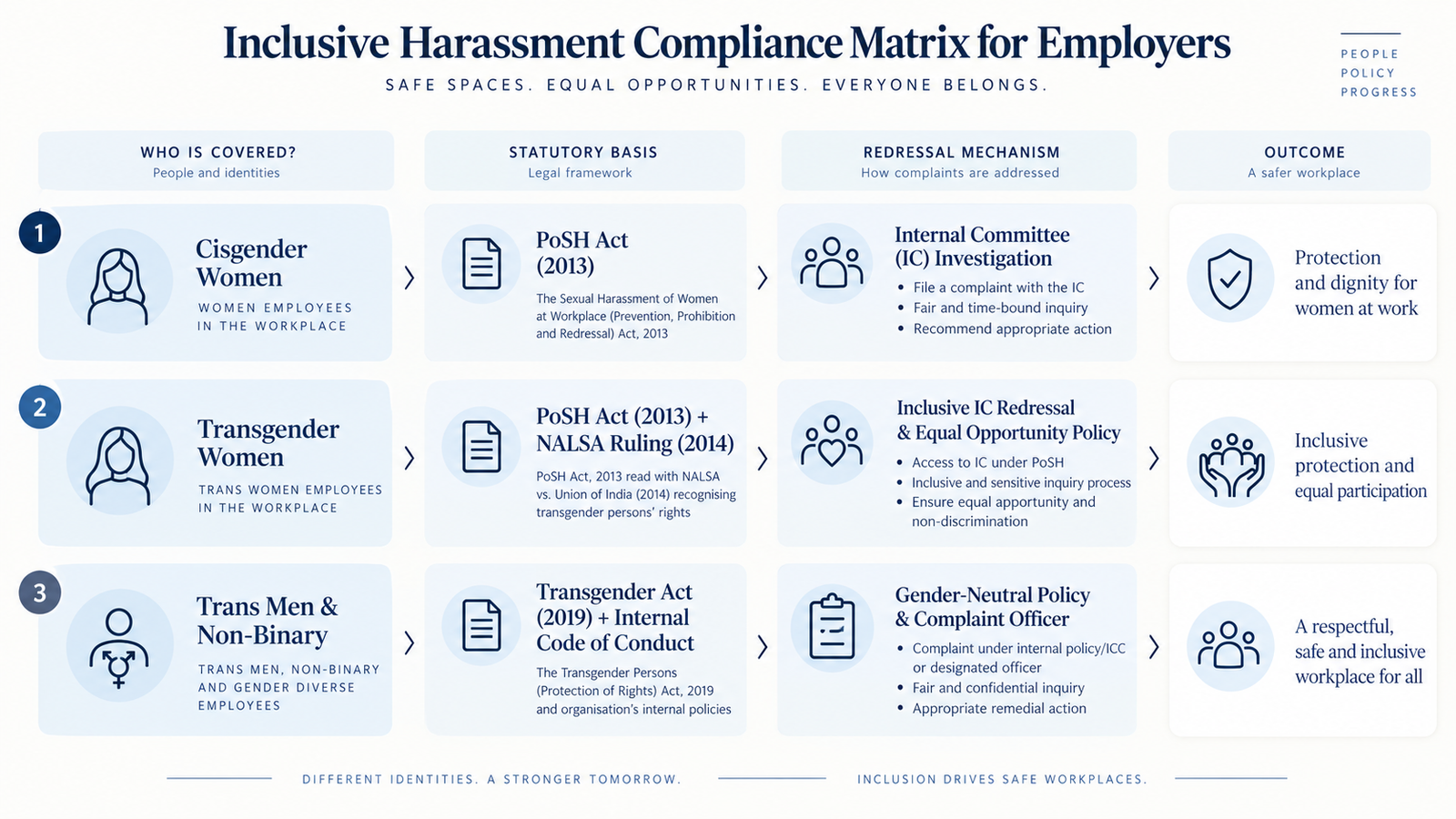
Actionable Compliance Steps for Employers and HR
To build a legally resilient and inclusive environment, organizations should implement the following steps:
- Adopt a Purposive IC Charter: Clarify within your internal PoSH policy that transgender women can submit grievances to the Internal Committee without procedural friction.
- Institute a Gender-Neutral Anti-Harassment Policy: Establish an overarching Code of Conduct covering sexual harassment experienced by male, trans male, or non-binary staff to ensure zero redressal gaps.
- Appoint a Complaint Officer: Fulfill obligations under the Transgender Persons Act (2019) by formally notifying a designated officer for transgender workplace grievances.
- Conduct Sensitization Sessions: Regularly train IC members, HR professionals, and managers on LGBTQ+ inclusivity, pronoun sensitivity, and confidential grievance handling.
Conclusion
While the PoSH Act’s text remains gender-specific, judicial developments and human rights principles demand that transgender women receive equal protection against sexual harassment. Employers who proactively align their PoSH policies with broader statutory mandates minimize legal liability while fostering a safe, respectful organizational culture.