
 WhatsApp
When a POSH complaint involves an external stakeholder—such as a client, vendor, contractor, or visiting consultant—Internal Committees (ICs) and HR teams often face an immediate jurisdictional bottleneck.
Under the Sexual Harassment of Women at Workplace (Prevention, Prohibition and Redressal) Act, 2013 (PoSH Act), an employer’s direct disciplinary powers extend primarily over their own employees. When an alleged perpetrator (Respondent) works for an external organization, stops responding to notices, or flatly refuses to participate in an inquiry, the employer cannot issue a subpoena or compel attendance.
However, stating "The respondent is not our employee, so we cannot act" is legally untenable and exposes the organization to significant legal and reputational liability.
While disciplinary jurisdiction may end at the boundary of your payroll, your legal duty to provide a safe working environment to your aggrieved employee does not. Here is a comprehensive framework for navigating third-party sexual harassment complaints when the accused party is non-cooperative or unreachable.
The Core Challenge: Jurisdictional Boundaries vs. Employer Duties
Section 2(o) of the PoSH Act defines a "workplace" expansively. It includes not just physical offices, but any place visited by the employee arising out of or during the course of employment, including transport provided by the employer.
Similarly, Section 2(a) defines an "aggrieved woman" broadly—covering women of any age, whether employed or not, who allege having been subjected to sexual harassment at the workplace.
The friction arises because Section 11 empowers the Internal Committee to conduct inquiries in accordance with service rules or principles of natural justice. When the Respondent belongs to a third-party entity:
- No Direct Disciplinary Control: The employer cannot suspend, withhold pay, or terminate the services of a non-employee.
- Attendance Refusal: The third party or their employer may ignore IC notices or refuse to appear.
- Evidence Access: Access to external CCTV footage, logbooks, or external witnesses may be restricted.
Despite these constraints, employers retain a statutory obligation under Section 19 to provide a safe working environment and assist the aggrieved employee if she chooses to pursue legal remedies.
Step-by-Step Protocol When an External Respondent Refuses to Participate
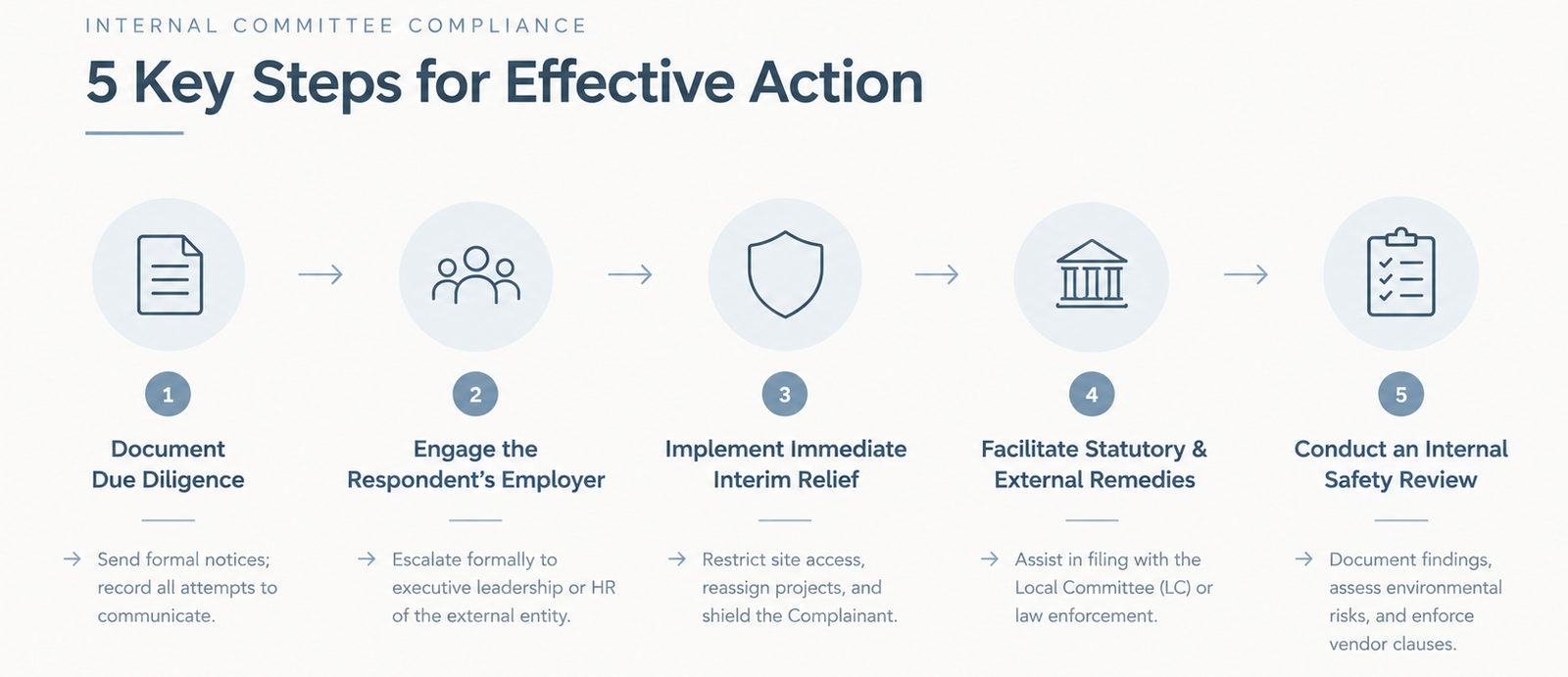
When a complaint is filed against a third party who fails to respond or refuses to participate in an inquiry, the IC and employer should follow a structured five-step protocol:
Internal Committee (IC) Jurisdiction
- Primary Target: Direct employees and internal contractors.
- Compulsory Attendance Power: Limited strictly to internal staff via company service rules.
- Disciplinary Sanctions: Disciplinary actions like warnings, salary deductions, or termination.
- Employer Role: Focuses on internal fact-finding, evidence collection, and providing workplace interim relief.
External / Statutory Mechanisms (Local Committee & Police)
- Primary Target: External stakeholders, third-party personnel, vendors, and unaffiliated individuals.
- Compulsory Attendance Power: Civil court powers under Section 11 (ability to issue summons or proceed ex-parte).
- Disciplinary Sanctions: Contractual/commercial termination, police prosecution, and binding statutory LC orders.
- Employer Role: Serves as a facilitator, evidence provider, and institutional support system for the employee.
Practical Checklist for HR and IC Members
When handling a third-party PoSH allegation, verify the following steps:
- [ ] Has the Complainant been provided immediate safety and interim relief?
- [ ] Have formal written notices been issued to the third-party Respondent with clear deadlines?
- [ ] Has formal communication been dispatched to the senior leadership/IC of the Respondent's employer?
- [ ] Has the employee been briefed on her option to approach the Local Committee (LC) or file an FIR under criminal law?
- [ ] Have commercial/vendor agreements been audited for PoSH compliance and termination clauses?
- [ ] Is the entire trajectory—notices, escalations, support provided—documented in the IC records?
Strategic Prevention: Strengthening Contracts and Vendor Protocols
To minimize operational disruption when third-party incidents occur, organizations should proactively institute three governance measures:
- Incorporate PoSH Clauses in B2B Contracts: Master Service Agreements (MSAs), vendor contracts, and client agreements should explicitly state that third-party personnel must adhere to PoSH standards and participate in inquiries if a complaint is raised.
- Visitor & Consultant Governance: Require external visitors, consultants, and contractors to sign or acknowledge the company’s Prevention of Sexual Harassment Policy prior to granting campus or system access.
- Cross-Organizational IC Coordination: Establish clear communication protocols between your IC and the ICs of key clients or vendors to streamline joint or cross-entity fact-finding.
Need Support Handling Complex or Third-Party PoSH Inquiries?
Navigating complaints involving non-employees, external vendors, or uncooperative respondents requires careful alignment between statutory PoSH provisions, employment law, and contract management. Mistakes in procedure can lead to legal exposure or fail the victim.
Poshaw provides end-to-end guidance to help organizations establish legally sound, practical compliance frameworks. Whether you need expert external IC members to navigate complex inquiries, specialized IC capacity-building workshops, or comprehensive PoSH policy reviews that cover vendor and client engagements, our team is here to assist.
- Explore Our Services: Poshaw Compliance Solutions
- Email: info@poshaw.in
- Phone: +91 9773831359 | +91 9999415757