
 WhatsApp
When an employee files a complaint alleging workplace sexual harassment—stating that a colleague touched her inappropriately while they were working alone on a late-night project—the Internal Committee (IC) is often confronted with an immediate challenge: there are no witnesses, no CCTV footage, no email trails, and no text messages.
In corporate compliance, this scenario is commonly referred to as a "he-said, she-said" complaint. A widespread and legally risky misconception among employers and IC members is that without physical, digital, or third-party testimonial evidence, a complaint cannot proceed and should be dismissed immediately at the threshold.
Dismissing a complaint solely due to the absence of direct eyewitnesses or documentary proof is a violation of the Sexual Harassment of Women at Workplace (Prevention, Prohibition and Redressal) Act, 2013 (PoSH Act). An IC’s statutory function is not to act as a criminal trial court seeking absolute proof, but to conduct a structured, fair inquiry into the consistency, probability, and credibility of the statements provided.
1. Why "Lack of Evidence" Is Not Grounds for Dismissal
Acts of workplace sexual harassment rarely take place in public view or in front of witnesses. They routinely occur behind closed doors, during isolated working hours, or in private interactions where digital records are nonexistent.
If the law required visual or documentary evidence to proceed, the statutory protection guaranteed by the PoSH Act would become redundant for a majority of aggrieved women. The absence of direct evidence does not render a complaint false or unsubstantiated; it simply shifts the nature of the inquiry from documentary verification to evaluating circumstantial material and narrative credibility.
2. The Legal Standard: Preponderance of Probabilities
In domestic disciplinary inquiries under the PoSH Act, the committee is not bound by the standard of proof required in criminal proceedings (which demands proof "beyond a reasonable doubt"). Instead, the inquiry is governed by civil law's standard: the Preponderance of Probabilities.
Under this standard, the IC must evaluate all material placed before it as a collective whole and determine: Is it more probable than not that the alleged incident occurred?
When direct evidence is unavailable, the IC evaluates probability by assessing the following factors:
- Internal Narrative Consistency: Does the complainant's statement remain coherent, detailed, and consistent throughout the written complaint and personal deposition?
- Surrounding Circumstances: Were the parties indeed assigned to work together alone at the relevant time and place? Was the meeting scheduled, or did the physical setup allow for such an incident to transpire?
- Contemporaneous Disclosure: Did the aggrieved person disclose the incident to a colleague, friend, relative, or counselor shortly after it happened? While secondary testimony does not prove the act itself, contemporaneous disclosure serves as strong corroborative evidence regarding the victim's immediate emotional state and consistency.
- Behavioral and Work Pattern Shift: Did either party exhibit sudden changes in work interactions, communication tones, meeting attendance, or professional dynamic immediately following the alleged date?
Judicial Precedent: X v. Union of India (2020)
This approach is firmly rooted in Indian jurisprudence. In X v. Union of India (2020 SCC OnLine Del 1618), the Delhi High Court specifically addressed inquiries lacking direct witnesses. The High Court observed that the absence of eyewitnesses cannot, by itself, detract from a complainant’s credibility. The Court underscored that requiring strict visual corroboration in cases of workplace sexual harassment would defeat the very object and intent of the PoSH legislation.
3. Upholding Principles of Natural Justice and Fairness
While the IC must evaluate the complainant’s testimony without dismissing it for lack of direct proof, it must maintain absolute neutrality toward the respondent. The absence of direct evidence does not give the IC liberty to presume guilt or bypass due process.
The inquiry must strictly observe the Principles of Natural Justice:
- Equal Opportunity to be Heard (Audi Alteram Partem): Both the complainant and the respondent must be given an adequate, unbiased opportunity to present their account, submit witness lists (if any circumstantial witnesses exist), and respond to queries.
- Right to Respond and Cross-Examine: The respondent must be served with a complete copy of the complaint along with all supporting statements or documents relied upon by the IC, allowing a fair timeframe to submit a written response and put forward defense statements.
- Absence of Bias: IC members must approach the inquiry with an open mind, refraining from premature opinions, gender bias, or assumptions regarding corporate hierarchy.
Judicial Precedent: Aureliano Fernandes v. State of Goa (2023)
In Aureliano Fernandes v. State of Goa (2023 SCC OnLine SC 621), the Supreme Court of India emphasized that domestic inquiries under the PoSH Act must strictly comply with natural justice principles. The apex court noted that procedural lapses or failure to afford the respondent a reasonable and fair opportunity to defend themselves invalidates the inquiry proceedings, highlighting that procedural fairness is non-negotiable.
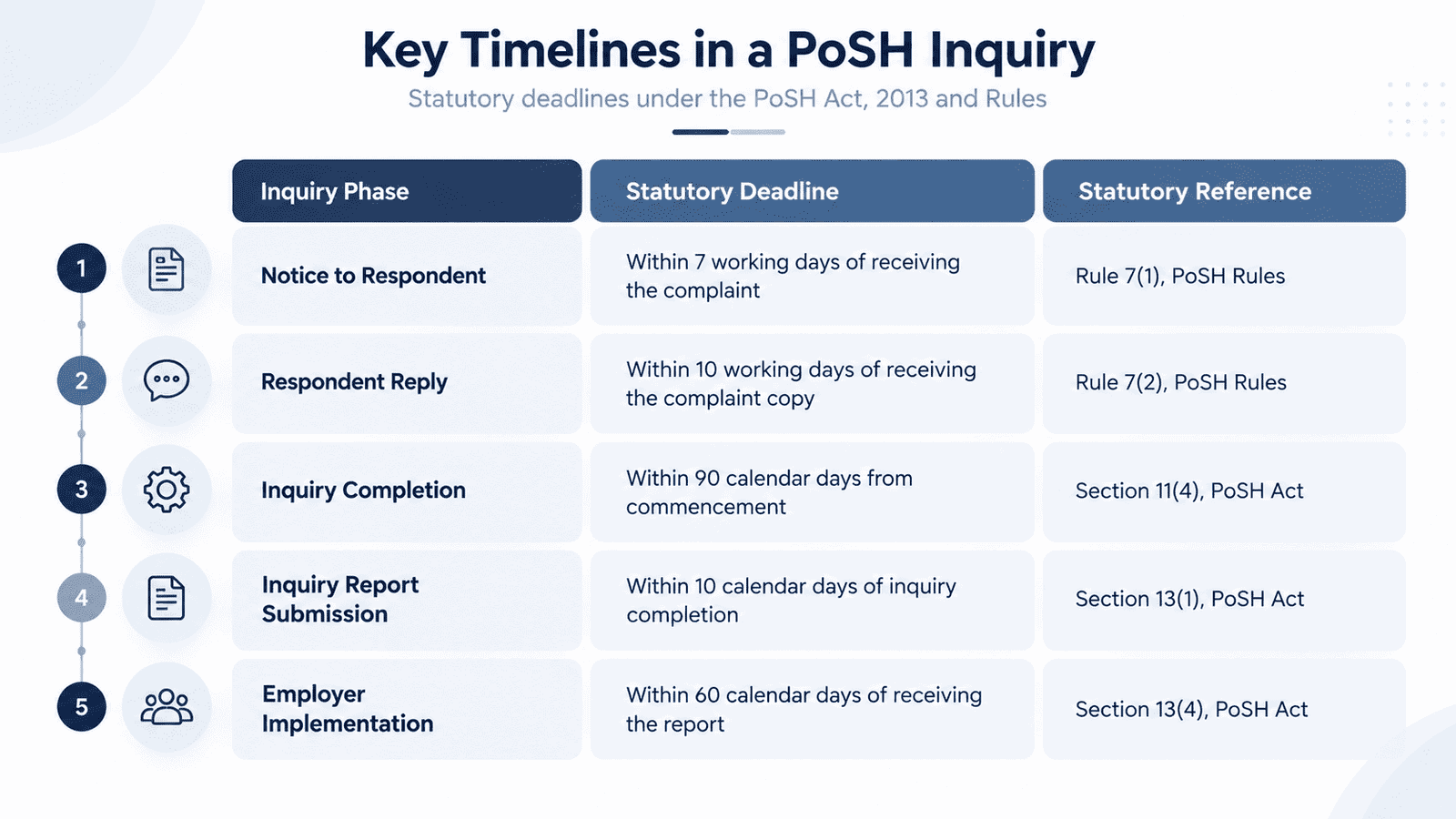
4. Statutory Timelines to Maintain Inquiry Integrity
When handling delicate word-against-word complaints, strict adherence to statutory timelines under the PoSH Act and Rules prevents procedural delays and ensures the integrity of the evidence recorded:
Practical Compliance Checklist for Internal Committees
When faced with a complaint involving zero direct evidence, Internal Committees should structure their process using these practical steps:
- Record Detailed Depositions: Ask open-ended, precise questions during depositions regarding time, spatial layout, sequence of events, and post-incident conduct rather than asking simple "yes/no" questions.
- Examine Circumstantial Witnesses: Call individuals who saw either party immediately before or after the incident, or persons to whom a disclosure was made contemporaneously.
- Assess Material Credibility: Document specific, objective reasons why one account is found more probable than another in the final findings. Avoid vague statements like "the committee felt."
- Draft Reasoned Findings: The final inquiry report must clearly detail how the committee weighed the evidence, why certain statements were accepted or rejected, and how the standard of preponderance of probabilities was satisfied.
NEED SUPPORT WITH YOUR INTERNAL COMMITTEE?
Handling complex, word-against-word inquiries requires experienced guidance to prevent procedural errors and legal exposure.
POSHAW works with corporate organizations across India to ensure airtight PoSH compliance and impartial inquiry management. Our team of expert advocates, external IC members, and legal advisors supports organizations with end-to-end statutory compliance.
Our Specialized Services Include:
- External IC Member Representation & Inquiry Advisory
- IC Capability-Building & Process Masterclasses
- PoSH Policy Drafting, Review & Compliance Gap Audits
- Annual Statutory PoSH Reporting & District Officer Coordination
- Employee & Manager Awareness Programs
Need guidance on handling a complex PoSH inquiry or strengthening your IC process?
- 🌐 Website: poshaw.in
- ✉️ Email: info@poshaw.in
- 📞 Phone: +91 9773831359 | +91 9999415757