
 WhatsApp
The POSH Amendment Bill 2024 proposes significant changes to India’s workplace sexual harassment law, including extending the time limit for filing a complaint from three months to twelve months and removing the conciliation process under Section 10 of the POSH Act.
However, the proposed amendment is not currently the law. Until it is formally enacted and brought into force, employers, Internal Committees and employees must continue to follow the POSH Act, 2013 and the POSH Rules, 2013.
What Is the POSH Amendment Bill 2024?
The Sexual Harassment of Women at Workplace (Prevention, Prohibition and Redressal) Amendment Bill, 2024 is a proposed amendment to the POSH Act, 2013.
The Bill was introduced in the Rajya Sabha on 2 February 2024 by Dr. Sasmit Patra as a Private Member’s Bill. It seeks to make the workplace sexual harassment complaint process more accessible and strengthen the formal inquiry mechanism.
The proposal focuses mainly on:
- Extending the time limit for filing a POSH complaint.
- Removing conciliation as a method of resolving a complaint before inquiry.
Since the proposal is a Bill and not an enacted Act, its provisions do not automatically apply to organisations or individuals.
Proposed Changes Under the Bill
1. Complaint Period May Increase From Three Months to Twelve Months
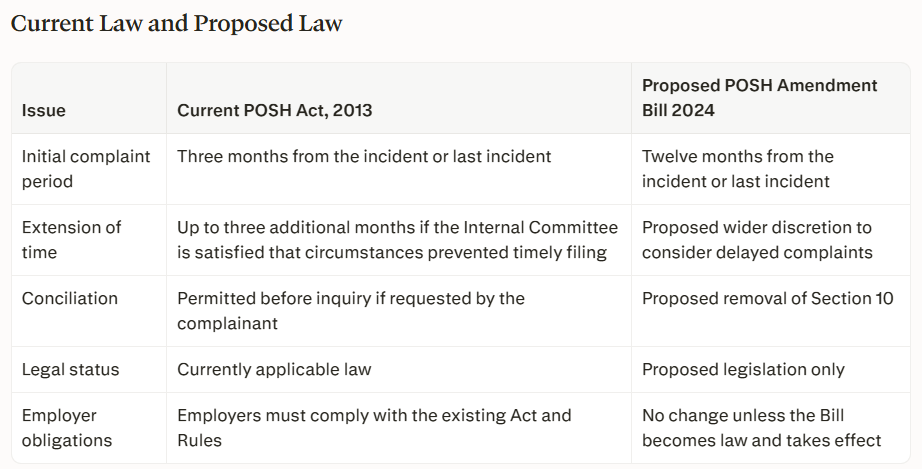
Under the existing POSH Act, a woman may generally file a written complaint with the Internal Committee within three months from the date of the alleged incident.
Where a series of incidents has taken place, the three-month period is generally counted from the date of the last incident.
The Internal Committee may extend the time limit by up to three additional months if it is satisfied that circumstances prevented the complainant from filing the complaint within the original period.
The POSH Amendment Bill 2024 proposes to extend the initial complaint period from three months to twelve months.
The proposed change may also provide the Internal Committee with wider discretion to consider complaints submitted after the proposed twelve-month period, depending on the circumstances of the case.
Why Is a Longer Complaint Period Important?
Many workplace sexual harassment complaints are not reported immediately. A complainant may require time to understand the conduct, assess available options or seek emotional and legal support.
A longer complaint period may help address situations involving:
- Fear of retaliation.
- Workplace pressure or unequal power relationships.
- Trauma, stress or mental health concerns.
- Dependence on the alleged respondent for employment or career progression.
- Lack of awareness about the POSH complaint process.
- Difficulty in collecting documents or identifying witnesses.
- Concerns about professional reputation or workplace relationships.
The proposed extension recognises that a person may not always be able to report workplace harassment immediately after an incident.
2. Conciliation May Be Removed
Section 10 of the existing POSH Act allows the Internal Committee to attempt conciliation between the complainant and the respondent before starting an inquiry.
Conciliation can be considered only when the complainant requests it. Monetary compensation cannot be the basis of such conciliation.
The POSH Amendment Bill 2024 proposes to remove Section 10 from the Act.
If the proposal becomes law, complaints would generally proceed through the formal inquiry process instead of being resolved through conciliation under the POSH Act.
Why Is Conciliation Being Reconsidered?
Conciliation in workplace sexual harassment matters can raise several concerns.
For example:
- A complainant may feel pressured to settle.
- The parties may not have equal bargaining power.
- An informal resolution may not reflect the seriousness of the allegations.
- A settlement may fail to address workplace safety concerns.
- The complainant may prefer a formal finding by the Internal Committee.
- Informal resolution may create uncertainty about accountability and future conduct.
Removing conciliation could create a more consistent process by requiring complaints to be handled through a formal inquiry.
At the same time, conciliation is currently available only when requested by the complainant. Removing it would also eliminate an option that some complainants may voluntarily prefer in suitable cases.
Current Law and Proposed Law
What Is the Current Status of the Bill?
The POSH Amendment Bill 2024 remains a proposed legislative amendment.
The introduction of a Bill in the Rajya Sabha does not mean that it has become law. Before its provisions can apply, the Bill would need to complete the required legislative process, receive Presidential assent and come into force in accordance with the applicable legal procedure.
The official Bill text indicates that commencement would depend on notification by the Central Government.
Therefore, the existing provisions of the POSH Act and Rules continue to apply.
This means that organisations should continue to follow:
- The existing three-month complaint period.
- The current extension mechanism.
- The existing provisions relating to conciliation.
- The present Internal Committee inquiry procedure.
- Existing annual reporting and compliance requirements.
Employers should not treat the proposed twelve-month complaint period as an enforceable statutory requirement unless and until the amendment is officially enacted and brought into force.
What Should Employers Do Now?
Employers should continue their POSH compliance activities under the current law while monitoring official developments.
Organisations should:
- Ensure that the Internal Committee is properly constituted.
- Appoint eligible members in accordance with the POSH Act.
- Display the POSH policy and complaint details at the workplace.
- Conduct regular employee awareness programmes.
- Provide specialised training to Internal Committee members.
- Maintain confidentiality throughout the complaint and inquiry process.
- Preserve relevant records and inquiry documents.
- Submit applicable annual reports within the prescribed timelines.
- Handle delayed complaints carefully and assess the reasons for delay.
- Avoid dismissing a complaint solely because it was not submitted immediately.
- Update internal policies only after confirming the final legal position.
A delayed complaint should be assessed fairly and in accordance with the existing law. The Internal Committee should consider the circumstances surrounding the delay instead of taking an overly technical approach.
What Should Employees Know?
Employees should understand that the proposed twelve-month complaint period is not yet the applicable rule.
A person who experiences sexual harassment at the workplace should consider reporting the incident as soon as reasonably possible through the appropriate Internal Committee or Local Committee.
Early reporting may help preserve:
- Emails and written communications.
- Text messages and workplace chat records.
- Meeting invitations and calendar entries.
- CCTV or access records, where available.
- Details of witnesses.
- Relevant documents and photographs.
- A personal record of dates, locations and events.
- Information about retaliation or adverse treatment.
If a complaint is delayed, the complainant should explain the reasons for the delay. Relevant circumstances may include fear, trauma, medical concerns, workplace pressure, retaliation or dependence on the respondent.
Frequently Asked Questions
Has the POSH Amendment Bill 2024 become law?
No. The Bill is a proposed amendment and does not automatically change the POSH Act. The existing POSH Act and Rules continue to apply.
What is the proposed new time limit for filing a POSH complaint?
The Bill proposes extending the initial complaint period from three months to twelve months from the date of the incident or the last incident in a series.
Does the Bill remove conciliation under the POSH Act?
Yes. The proposal seeks to remove Section 10, which currently allows conciliation before an inquiry when requested by the complainant.
Can an organization apply the twelve-month period immediately?
No. Organizations should follow the provisions of the law currently in force. The proposed amendment should not be treated as an existing legal obligation.
What should an Internal Committee do if a complaint is delayed?
The Internal Committee should assess the complaint and consider the reasons for the delay under the existing provisions of the POSH Act. A delay should not automatically result in rejection without proper consideration.
Should companies update their POSH policy now?
Companies may review their policies and prepare for possible legal changes, but they should continue complying with the POSH Act and Rules currently in force. Any formal policy change should be based on an officially enacted amendment.
Conclusion
The POSH Amendment Bill 2024 proposes two important changes to India’s workplace sexual harassment framework.
First, it seeks to extend the complaint period from three months to twelve months. Second, it proposes to remove the conciliation mechanism under Section 10 of the POSH Act.
These changes could make the reporting process more accessible and encourage formal inquiry into workplace sexual harassment complaints. However, the Bill has not automatically become law.
Until the proposed amendment is passed and brought into force, employers and Internal Committees must continue following the POSH Act, 2013 and the POSH Rules, 2013.
Organizations should continue conducting POSH training, maintaining a functioning Internal Committee, protecting confidentiality and responding promptly and fairly to every complaint.
Bill vs. Law: Understanding the Status of Proposed POSH Act Amendments
With conversations around proposed amendments to workplace safety legislation gaining traction, it’s important to understand where these changes actually stand in the legal process.
A frequent source of confusion is the difference between a Bill and a Law. Here is a quick breakdown of how the legislative process works in India and what it means for your workplace today.
What Is a Bill?
In the Indian legislative system, a Bill is simply a draft proposal for a new law or an amendment to existing legislation. Before any proposal becomes enforceable, it must go through a rigorous multi-step process:
- Introduction & Debate: Scrutiny and discussion in both the Lok Sabha and the Rajya Sabha.
- Voting: Approval by a majority in both Houses of Parliament.
- Presidential Assent: Formal signature by the President of India.
Only after receiving Presidential assent is a Bill formally enacted into an Act and granted the status of Law.
What This Means for the POSH Act Today
Because any proposed changes are currently in the Bill stage, they do not carry legal force yet.
Until the proposed amendments complete the full parliamentary process and are formally enacted:
- The existing provisions of the Sexual Harassment of Women at Workplace (Prevention, Prohibition and Redressal) Act, 2013 and its 2013 Rules remain in full effect.
- Organizations must continue to strictly follow current POSH compliance standards and Internal Committee (IC) redressal mechanisms.
What’s Next?
Proposed legislative updates can shift compliance requirements, but no action is required regarding the draft amendments just yet. We are actively monitoring the progress of this Amendment Bill through Parliament and will share timely updates as official developments occur.
Stay tuned to our blog for further legal updates and workplace compliance guidance.