
 WhatsApp
The National Commission for Women (NCW) issued a comprehensive nationwide advisory addressed to States and Union Territories, emphasizing stringent enforcement and systematic monitoring under the Sexual Harassment of Women at Workplace (Prevention, Prohibition and Redressal) Act, 2013 (POSH Act). Released under the leadership of NCW Chairperson Smt. Vijaya Rahatkar, the June 2026 directive shifts the compliance landscape from passive adherence to active institutional accountability.
For founders, human resources professionals, and corporate leaders, this advisory signals a critical pivot. Compliance is no longer just about having a static policy document tucked away in an employee handbook; it requires verifiable metrics, regular audits, and robust grievance redressal frameworks.
The Regulatory Shift: Understanding the NCW Advisory
While the PoSH Act has mandated workplace safety and Internal Committee (IC) formations since 2013, enforcement mechanisms at the grassroots and state levels have historically varied. The NCW’s latest directive aims to bridge this gap by establishing structured oversight through Chief Secretaries, Directors General of Police, and District Magistrates across all states and UTs.
The core of this directive introduces mandatory annual PoSH audits for all establishments employing ten or more persons. This requirement transforms routine compliance into a formal evaluation process where organizations must review their internal mechanisms, training records, and complaint handling procedures.
Key Compliance Imperatives for Employers and HR
To align with the NCW’s framework, organizations must evaluate their current standing against several critical compliance markers outlined in the advisory:
- Mandatory Annual Audits: Establishments with 10 or more employees must undergo structured annual PoSH audits. These audits examine the functioning of ICs, confidentiality safeguards, complaint statuses, and the utilization of the government's SHe-Box platform.
- State-Level Digital Monitoring Cells: States are advised to establish dedicated monitoring cells and digital compliance dashboards to track implementation and review establishment data periodically.
- Universal and Compliant IC Constitution: Every branch or unit with 10+ employees must constitute an Internal Committee. These committees must strictly mirror statutory requirements: a woman Presiding Officer, qualified members, at least 50 percent female representation, and an independent external member.
- Active Integration of SHe-Box: Institutions are directed to promote awareness and utilization of the centralized SHe-Box platform for streamlined online grievance registration and monitoring.
- Protection Against Retaliation: Organizations must establish clear safeguards to protect complainants, witnesses, and IC members from victimization, professional prejudice, or adverse transfers.
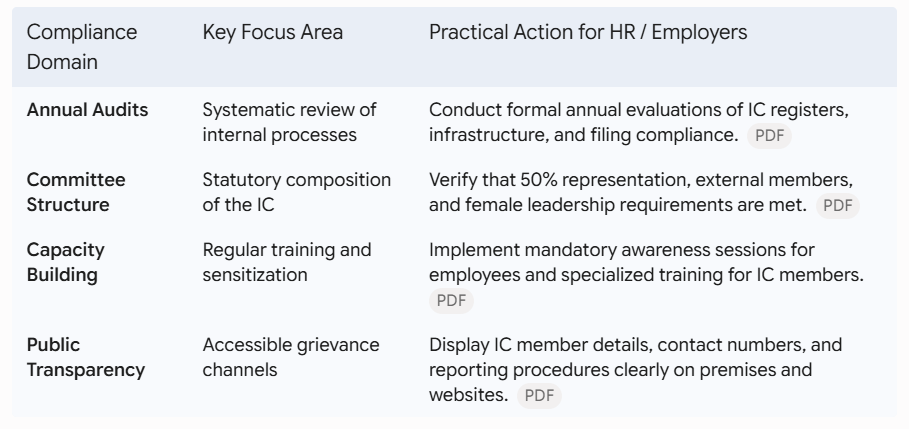
Summary of NCW Audit Focus Areas
The table below outlines the primary compliance domains highlighted in the NCW advisory and their practical implications for business leaders.
Practical Steps for Proactive Compliance
With district administrations tasked with active monitoring and reviewing audit findings, organizations should adopt a proactive stance:
- Conduct an Internal Gap Analysis: Review existing PoSH policies, filing systems, and annual report submissions to identify potential compliance gaps before external reviews take place.
- Upgrade IC Capabilities: Ensure that Internal Committee members undergo professional development and specialized training to handle sensitive inquiries lawfully and fairly.
- Enhance Visibility: Confirm that contact details of IC members and Nodal Officers are prominently displayed across physical office locations and digital portals.
- Maintain Comprehensive Documentation: Keep meticulous records of all employee awareness workshops, orientation programs, and committee meetings to substantiate compliance during district-level evaluations.
Frequently Asked Questions
Are annual PoSH audits mandatory for all businesses?
Under the NCW advisory framework, establishments employing ten or more persons are subject to mandatory annual PoSH audits assessing legal compliance, IC functionality, and safety measures.
What is the role of District Authorities under the new advisory?
District Officers and administrative bodies act as nodal authorities for implementation, monitoring, grievance redressal, and reviewing establishment audit findings within their respective jurisdictions.
How does the SHe-Box platform fit into compliance?
The SHe-Box platform serves as the Government of India's centralized digital tool for the online registration, tracking, and monitoring of workplace sexual harassment complaints. Its effective utilization is a key metric in compliance reviews.
Sources / Legal References:
- National Commission for Women (NCW) Press Release & Advisory: NCW Issues Advisory to States, Calls for Mandatory POSH Audits and Robust Workplace Safety Mechanisms Nationwide (New Delhi, June 19, 2026, issued by Shivam Garg, Media Advisor).
- The Sexual Harassment of Women at Workplace (Prevention, Prohibition and Redressal) Act, 2013 (POSH Act).