
 WhatsApp
In a landmark judgment shaping workplace harassment jurisprudence—Anup Vikal v. State of Maharashtra and Ors. (WP No. 7430 of 2026)—the Bombay High Court ruled that an Internal Committee (IC) cannot dispose of a workplace sexual harassment complaint at the threshold without following due process. The Court, led by Justice Sandeep V. Marne, held that an IC’s decision to close a case on the grounds that it lacks a "sexual element" operates as a recommendation under Section 13(2) of the PoSH Act, making it appealable by the aggrieved woman under Section 18.
The High Court emphasized that the Sexual Harassment of Women at Workplace (Prevention, Prohibition and Redressal) Act, 2013 is a social welfare law enacted to protect women. Allowing ICs to summarily close complaints without a fair hearing would frustrate the statute’s purpose and leave aggrieved women "remediless."
For employers, HR leaders, and IC members across India, this ruling makes one thing clear: procedural shortcuts or threshold rejections carry severe legal risks and judicial oversight.
Factual Background of the Case
In Anup Vikal v. State of Maharashtra, the complainant (formerly General Counsel at Maple Infra) filed a formal PoSH complaint with the company's Internal Committee (IC) on October 28, 2023. Within 23 minutes of notifying the complainant that the matter had been referred to an External Member, the IC sent an email closing the complaint. The IC stated that after "thorough deliberations," it determined the allegations contained no "sexual element" and thus fell outside its jurisdiction.
The complainant challenged this threshold rejection before the Industrial Court in Mumbai under Section 18 of the PoSH Act. The employer and petitioners argued that because no formal Section 11 inquiry was conducted, the IC’s email was a mere administrative communication—not a statutory "recommendation" under Section 13—and therefore could not be appealed under Section 18.
The Industrial Court rejected the maintainability objection and set aside the IC’s email. The petitioners appealed to the Bombay High Court.
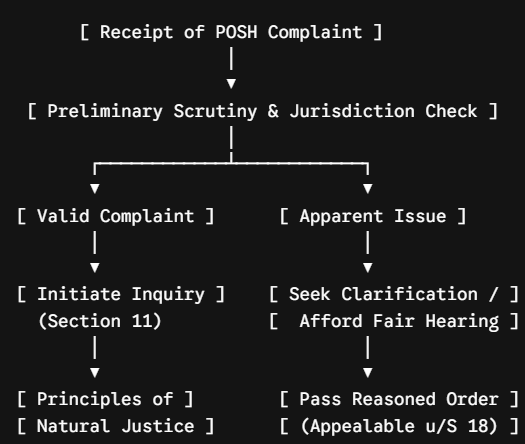
Key Legal Findings of the High Court
Justice Sandeep V. Marne delivered a comprehensive ruling addressing the statutory framework of the PoSH Act:
- Threshold Closure as a Section 13 Recommendation:
- The High Court held that when an IC examines a complaint and concludes that no sexual harassment took place (or that allegations lack a sexual element), that decision constitutes a recommendation under Section 13(2) that "no action is required." As a result, the complainant has the explicit statutory right to appeal under Section 18.
- Inquiry Deficits Cannot Block Appeals:
- The petitioners argued that an appeal under Section 18 can only follow a completed Section 11 inquiry. The High Court firmly rejected this logic, holding that an IC’s failure to hold an inquiry vitiates its procedure but does not strip the decision of its character as an appealable recommendation.
- Purposive & Liberal Interpretation:
- The Court underlined that the PoSH Act is remedial legislation. Adopting a hyper-technical view that denies appellate remedies whenever an IC bypasses an inquiry would create a procedural loop that deprives victims of redressal.
- Procedural Clarity on Remand:
- While upholding that the appeal was maintainable under Section 18, the High Court clarified that appellate courts must first evaluate maintainability and hear parties on merits before remanding a case back to the IC.
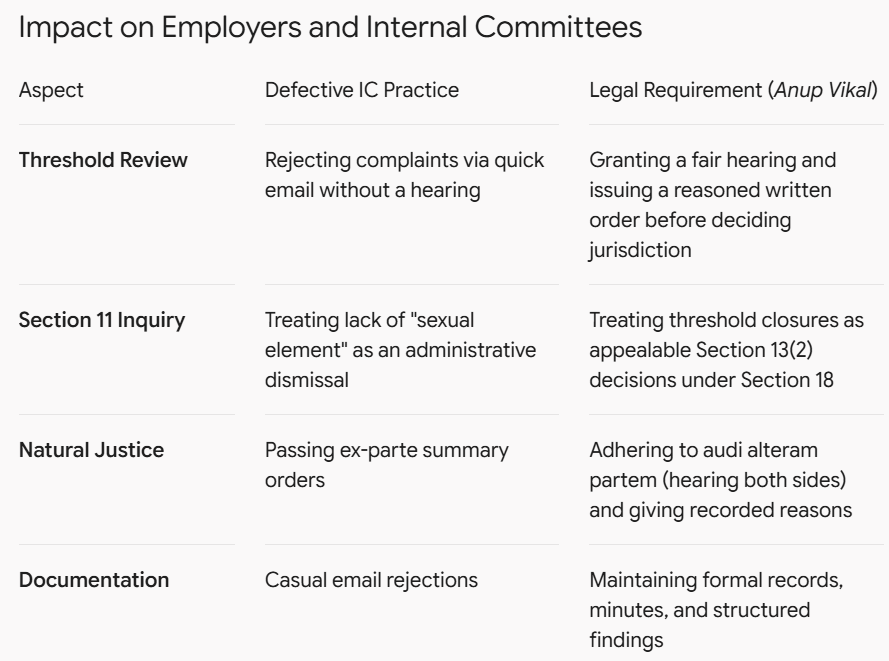
Practical Compliance Checklist for HR and ICs
To protect your organization from procedural invalidity and legal challenges, adopt the following operational practices:
- Avoid Immediate Dismissals: Even if a complaint appears on its face to lack a sexual element, the IC must not issue a summary closure email. Schedule a preliminary clarification meeting with the complainant to record their statement.
- Draft Reasoned Orders: Every decision—including jurisdictional closures—must be documented in a written, reasoned order signed by the IC. State the precise facts reviewed and reasons for the finding.
- Inform Parties of Appellate Rights: Because threshold rejections function as Section 13 recommendations, notify the complainant of their right to appeal under Section 18 within 90 days.
- Conduct Regular IC Training: Train committee members on quasi-judicial standards, procedural rules under Section 11, and the scope of natural justice.
- Leverage Neutral External Members: Ensure your IC’s External Member actively participates in preliminary reviews to prevent hasty, legally vulnerable rejections.
Need Guidance on Internal Committee Inquiry Procedures?
Failing to follow procedural requirements or dismissing complaints without proper inquiry exposes your organization to severe legal risks and judicial scrutiny. Ensuring your Internal Committee operates with legal clarity, fairness, and strict adherence to natural justice is essential for PoSH compliance.
Poshaw provides comprehensive Internal Committee training, External Member support, and end-to-end PoSH policy and inquiry guidance. We help your HR teams and IC members navigate complex complaints while maintaining full compliance with statutory laws and court mandates.
- Website: https://poshaw.in/
- Email: info@poshaw.in
- Phone: +91 9773831359 | +91 9999415757