
 WhatsApp
When India enacted the Sexual Harassment of Women at Workplace (Prevention, Prohibition and Redressal) Act, 2013 ("POSH Act"), it created a vital statutory safeguard for women at work. More than a decade later, Indian workplaces have evolved significantly—becoming increasingly inclusive of LGBTQIA+ employees, including transgender and non-binary professionals.
Yet, the POSH Act remains strictly gender-specific on the complainant side: under Section 2(a), only an “aggrieved woman” may initiate its statutory redressal process.
This creates a practical and ethical dilemma for progressive organizations: How do they protect male, transgender, and non-binary employees from workplace sexual harassment while remaining fully compliant with the POSH Act?
The answer is not to dilute statutory protections for women. Instead, organizations should maintain a fully compliant POSH framework while introducing a separate, carefully drafted gender-neutral workplace misconduct policy for employees outside the POSH Act’s statutory definition.
The Statutory Limitation of POSH
The POSH Act defines an “aggrieved woman” as a woman of any age, whether employed or not, who alleges she has been subjected to sexual harassment at a workplace. Section 2(n) defines sexual harassment, Section 3 prohibits it, and Section 9 establishes the complaint mechanism through the Internal Complaints Committee (ICC).
This means the statutory POSH mechanism is available to women complainants, but not to men, transgender men, or non-binary employees seeking redressal for sexual harassment.
Note on Accused Parties: This limitation relates strictly to who can complain, not who can be accused. A respondent under the POSH Act may be of any gender, and same-sex harassment complaints involving female complainants have been recognized as maintainable.
Who is Left Outside POSH?
1. Men
Male employees who experience sexual harassment cannot file a complaint under the statutory POSH framework. They must rely on general internal disciplinary policies, codes of conduct, or civil and criminal remedies.
2. Transgender Men and Non-Binary Employees
Because the Act defines the complainant exclusively as a “woman,” transgender men and non-binary employees fall outside its scope. While they have broad protections under the Transgender Persons (Protection of Rights) Act, 2019, that legislation does not provide a robust, POSH-equivalent inquiry mechanism.
3. Transgender Women
Transgender women may theoretically be covered under POSH as “women,” particularly following the landmark recognition of self-identified gender identity in NALSA v. Union of India (2014). However, because the POSH Act predates modern legal frameworks on gender identity, ICCs often face procedural uncertainty when handling such complaints, highlighting the need for specialized sensitization.
The Transgender Protection Gap
The Transgender Persons (Protection of Rights) Act, 2019 prohibits discrimination against transgender persons in employment—including recruitment and promotion—and requires every establishment to designate a complaint officer.
However, it does not prescribe a detailed inquiry mechanism equivalent to POSH. It does not create an ICC equipped with civil court powers, strict timelines, confidentiality safeguards, interim reliefs, and statutory appeal rights. Employers must proactively bridge this operational gap through internal policy design.
Why a Dual Framework is Needed
Relying solely on a statutory POSH policy leaves blind spots in employee safety. It also creates reputational, cultural, and legal risks for organizations that claim to be inclusive but fail to offer a credible grievance redressal route to all staff.
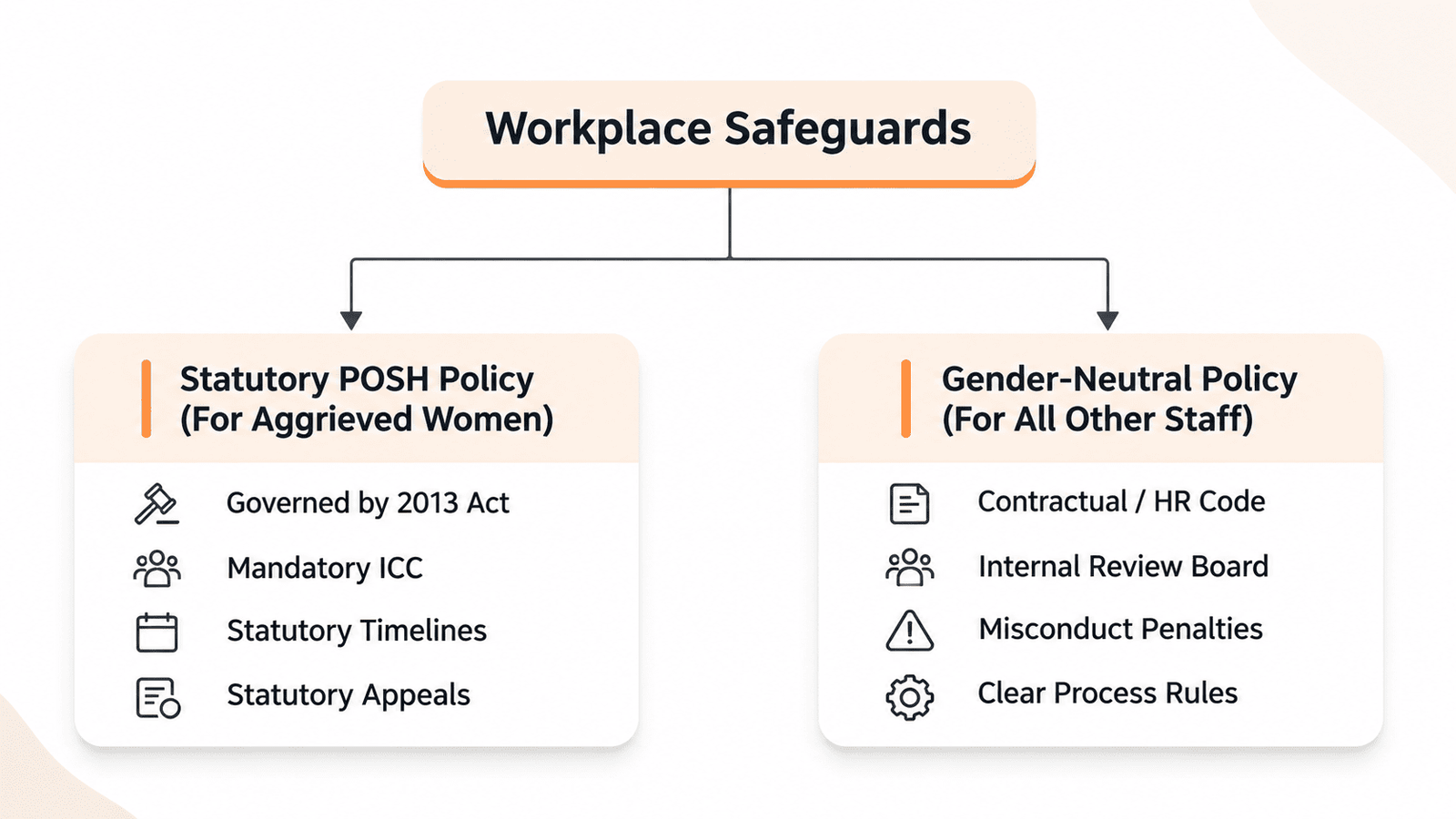
The solution is a Dual-Policy Framework:
1. Maintain the Statutory POSH Policy
Organizations must retain the statutory POSH policy exclusively for women complainants. The ICC’s composition, complaint process, inquiry procedure, timelines, confidentiality obligations, interim reliefs, and appeal remedies must remain fully aligned with the Act and Rules.
2. Implement a Gender-Neutral Misconduct Policy
Organizations should introduce a standalone gender-neutral workplace harassment and misconduct policy for male, transgender, non-binary, and gender-non-conforming employees. This operates as a contractual and disciplinary framework rather than a replacement for POSH, covering:
- Sexual harassment, gender-based harassment, and discrimination based on gender identity or expression.
- Physical, verbal, visual, digital, and virtual misconduct.
- Employees, interns, contractors, and other covered workers.
- Confidential reporting channels and a clearly constituted internal review panel.
- Fair investigation procedures, evidence handling, interim measures, and clear disciplinary consequences.
Key Legal Safeguards for HR and Legal Teams
- Do Not Dilute Statutory POSH Rights: A gender-neutral policy can never override, replace, or reduce the rights available to women under the POSH Act. The statutory ICC and its prescribed processes must remain separate and uncompromised.
- Define Review Authorities Clearly: An ICC derives its powers directly from statute (including civil court powers to summon witnesses on oath). By contrast, a non-statutory panel handling complaints from men or non-binary employees derives its authority from employment contracts, service rules, and internal disciplinary frameworks. Policies must explicitly state jurisdiction, panel constitution, conflict-of-interest protocols, and appeal mechanisms.
- Apply Natural Justice Consistently: Whether an inquiry is conducted under POSH or the internal gender-neutral policy, both frameworks must uphold strict confidentiality, impartial investigation, a fair opportunity for both parties to be heard, protection against retaliation, and prompt interim measures.
Key Action Items for HR & Legal Teams
- Audit Current Policies: Review existing POSH frameworks to identify coverage gaps for male, transgender, and non-binary employees.
- Verify POSH Compliance: Ensure statutory POSH policies, ICC compositions, and complaint workflows remain strictly compliant with the 2013 Act and Rules.
- Draft the Complementary Policy: Establish an Equal Opportunity and Gender-Neutral Harassment Policy under internal misconduct and disciplinary rules.
- Demarcate Jurisdiction: Clearly separate the statutory ICC’s mandate from the internal review panel's scope.
- Train Stakeholders: Conduct specialized training for ICC members, HR representatives, and internal review panels on gender sensitivity, confidentiality, and procedural fairness.
- Communicate Transparently: Ensure reporting channels for both frameworks are clearly visible and accessible to all employees.
- Periodic Review: Continuously evaluate policies as judicial interpretations, regulatory guidance, and workplace best practices evolve.
True workplace inclusion goes beyond hiring diversity—it requires equal safety, dignity, and credible grievance redressal for every employee, regardless of gender identity.
Strengthen Your Workplace Compliance Framework:
Bridging statutory compliance and inclusive safety requires careful drafting of gender-neutral workplace misconduct policies alongside your mandatory POSH framework. Whether you need assistance with dual-policy structuring, Internal Committee training, or External Member support, Poshaw provides end-to-end solutions tailored to your organization.
- Email: info@poshaw.in
- Phone: +91 9773831359 / +91 9999415757
- Website: https://poshaw.in/