
 WhatsApp
When an employee submits a complaint to an organization’s Internal Committee (IC), the committee's immediate duty is to review the allegations. In practice, IC members sometimes read a complaint and come to a quick conclusion: “This looks like a general workplace dispute, a performance feedback issue, or administrative friction—there is no sexual element here.”
When an IC reaches this initial view, can it simply issue a letter informing the complainant that the matter is closed because it falls outside the scope of the Sexual Harassment of Women at Workplace (Prevention, Prohibition and Redressal) Act, 2013 (PoSH Act)? Or does closing a complaint at the threshold without a formal inquiry carry legal risks and trigger statutory rights of appeal?
The legal boundary between preliminary administrative screening and a formal statutory inquiry is a crucial compliance question for employers, HR professionals, and IC members.
The Threshold Question: Jurisdiction vs. Inappropriateness
The PoSH Act was enacted to provide a specialized, sensitive, and expedited forum for resolving complaints of sexual harassment at the workplace. Under Section 2(n) of the Act, "sexual harassment" includes unwelcome physical contact, demands or requests for sexual favors, sexually colored remarks, showing pornography, or any other unwelcome physical, verbal, or non-verbal conduct of a sexual nature. Furthermore, Sections 3(2) creates liability for implicit or explicit promises of preferential treatment or threats of detrimental treatment (quid pro quo) linked to sexual behavior, as well as creating an intimidating or hostile work environment.
However, not every workplace grievance constitutes sexual harassment under the PoSH Act. Disagreements over performance appraisals, routine management directions, interpersonal conflicts, or general workplace bullying without a sexual element fall outside the statutory mandate of an Internal Committee.
This creates a procedural dilemma for ICs: How should an IC legally handle a complaint that, on its face, appears to lack any sexual element?
Key Judicial Insight: Anup Vikal v. State of Maharashtra & Ors.
The legal consequences of an IC rejecting a complaint at the initial stage were examined by the Bombay High Court in Anup Vikal v. State of Maharashtra & Ors. (2024).
What Happened in the Case?
An employee lodged a complaint before the Internal Committee. Upon reviewing the written submission, the IC communicated to the complainant that, after examining the allegations, it had concluded there was no sexual element involved. Consequently, the IC stated that the complaint did not fall within its jurisdiction to conduct an inquiry under the PoSH Act and closed the matter at the threshold.
The complainant challenged this communication by filing an appeal under Section 18 of the PoSH Act. The primary legal question before the High Court was whether the IC’s threshold rejection letter constituted an appealable order under the Act.
The Court’s Legal Findings
- Communication as a Recommendation: The Bombay High Court held that when an IC formally communicates to the parties that a complaint does not disclose a PoSH offense and will not be inquired into, such a communication amounts to a "recommendation" or final determination under the framework of Section 13(2) of the Act.
- Maintainability of Appeal under Section 18: Section 18 of the PoSH Act permits any person aggrieved by the recommendations made under Section 13(2) (or non-implementation of recommendations) to prefer an appeal to the appellate authority (such as an Industrial Tribunal or Labour Court) within 90 days. The Court clarified that an IC cannot shield its threshold rejection from judicial scrutiny by labeling it an informal administrative decision.
Why Threshold Rejections Are Legally Vulnerable
Dismissing a complaint at the threshold based on a brief initial reading presents significant legal and procedural risks for organizations:
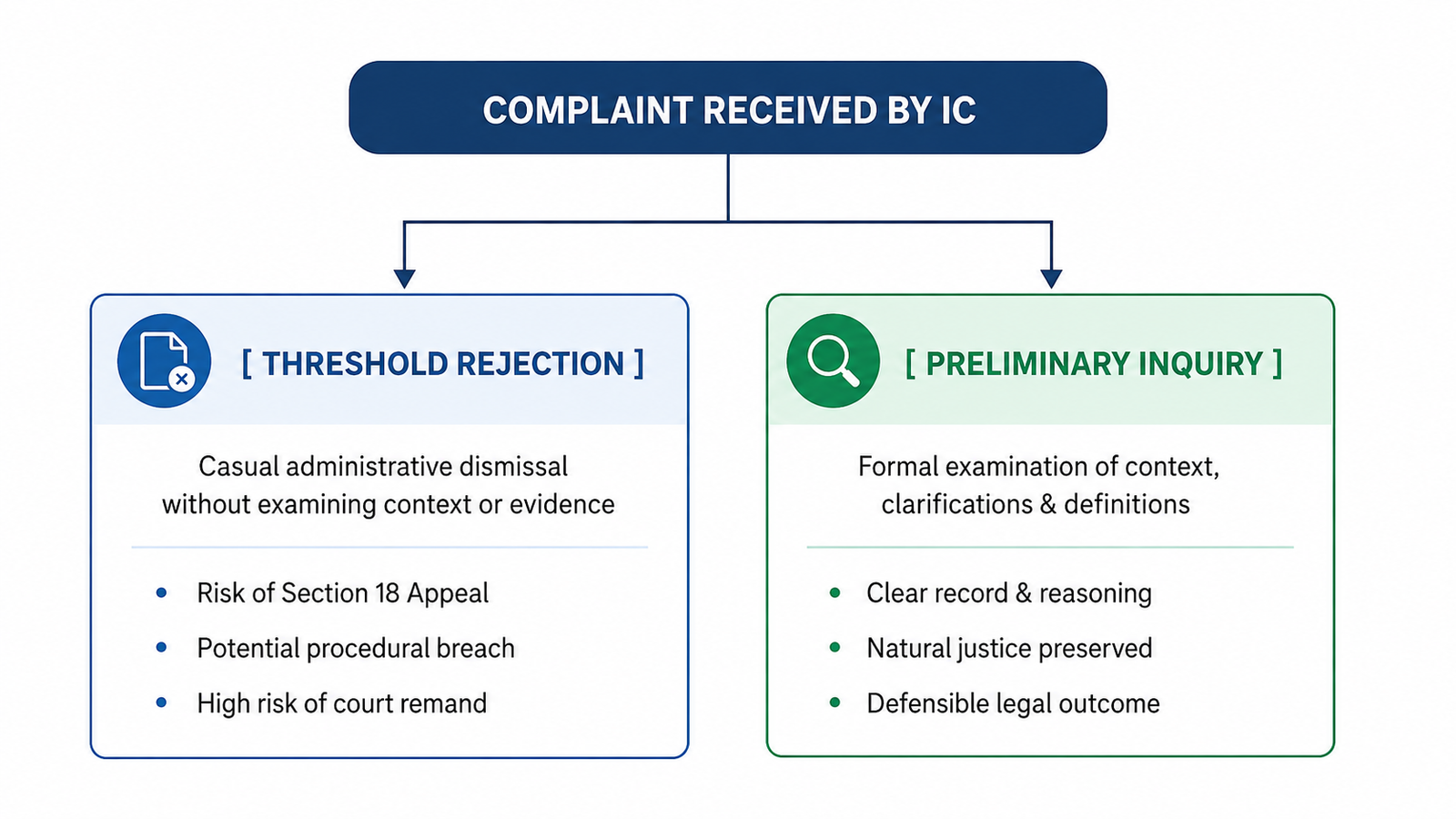
1. Nuance and Context Can Be Overlooked
Complainants are rarely legal experts. A written complaint may describe workplace hostility, isolation, or unfair treatment without explicitly using legal terminology. Without seeking preliminary clarifications or examining the surrounding context, an IC risks dismissing a genuine grievance where the sexual or gender-based nature of the conduct is implicit.
2. Principles of Natural Justice
The PoSH framework is grounded in principles of natural justice. Dismissing a complaint without providing the complainant an opportunity to clarify their allegations, present context, or understand the IC's jurisdiction can violate procedural fairness.
3. Exposure to Statutory Appeals
As affirmed in Anup Vikal, a formal letter closing a case at the threshold does not end the matter; it opens the door to a Section 18 appeal. If an appellate body finds the IC's threshold rejection was casual or premature, it can set aside the decision and remand the matter back for a full inquiry, delaying resolution and increasing legal exposure.
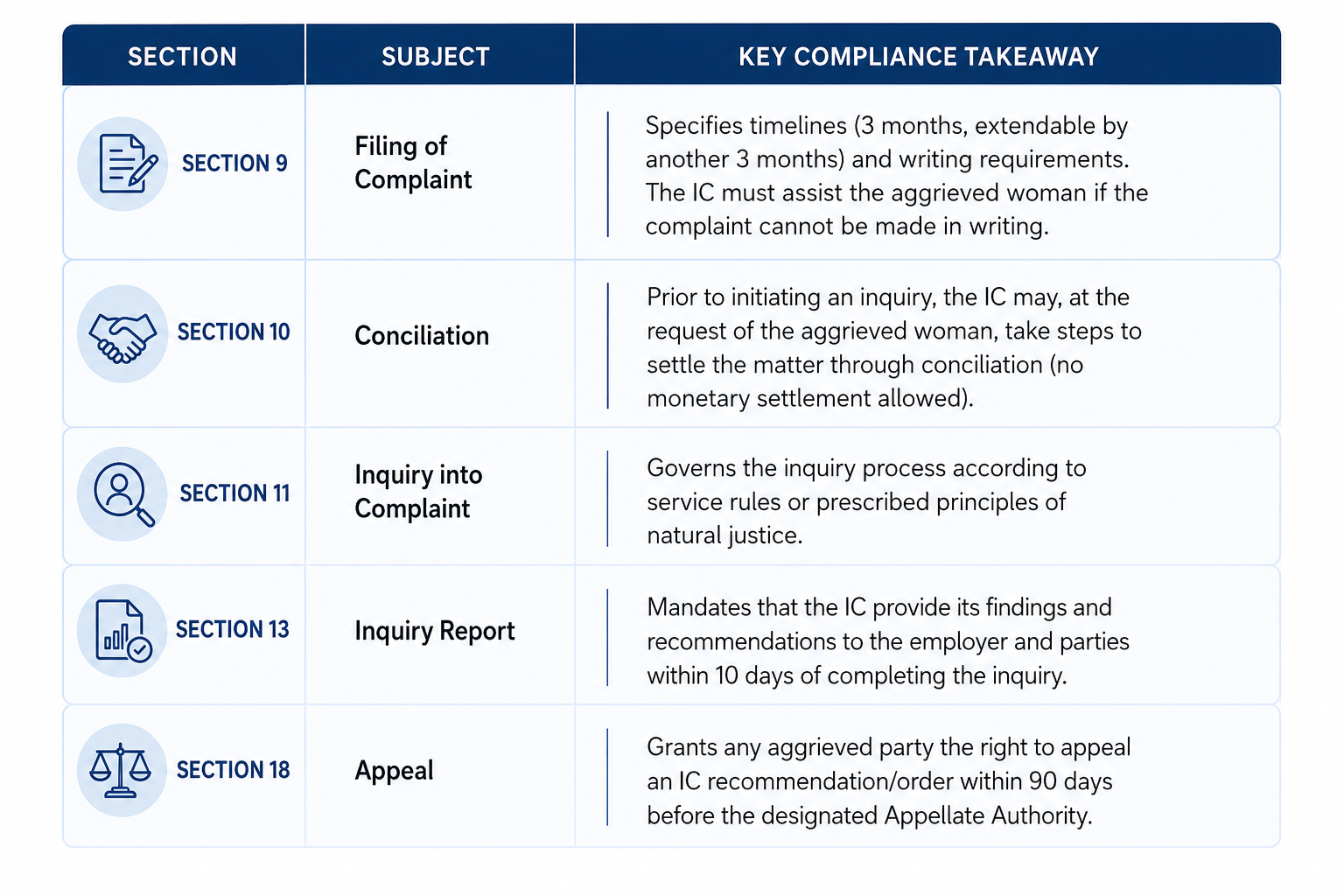
Statutory Provisions Governing IC Decisions
To maintain compliance, IC members and HR teams should evaluate initial decisions against the core structure of the PoSH Act, 2013:
Practical Compliance Framework: How ICs Should Handle Initial Threshold Reviews
An Internal Committee is not required to conduct a 90-day formal trial for a grievance that clearly lacks any nexus to sexual harassment or workplace power dynamics under the Act. However, the process of determining jurisdiction must be structured, documented, and legally sound.
Here is the step-by-step procedural framework ICs should follow:
Step 1: Conduct a Documented Preliminary Examination
When a complaint is received, the IC should hold a formal meeting to review the written submission against the definitions in Sections 2(n) and 3(2) of the Act.
Step 2: Seek Clarification (If Allegations Are Ambiguous)
If the written text is vague, incomplete, or ambiguous, the IC should not make assumptions. It should invite the complainant for a preliminary interaction to clarify the facts and understand the specific nature of the alleged behavior.
Step 3: Record a Reasoned Order on Jurisdiction
If, after preliminary review and clarification, the IC determines that the allegations do not fall within the scope of the PoSH Act:
- Do not issue a single-line email stating "Case Closed."
- Pass a reasoned, written order citing specific provisions of the Act and explaining why the facts alleged do not satisfy the statutory definition of sexual harassment.
- Maintain complete confidentiality and archive the decision minutes.
Step 4: Referral to Appropriate HR/Grievance Redressal Mechanisms
If the matter is determined not to be a PoSH case but involves general misconduct, workplace bullying, or managerial disputes, the IC should, with the complainant's knowledge, direct or recommend the matter to the company’s HR or Internal Grievance Cell for review under general company service rules.
Common Compliance Mistakes to Avoid
- Dismissing Complaints on First Impression: Concluding a complaint is non-PoSH solely based on brief initial phrasing without seeking necessary clarification.
- Confusing Merits with Jurisdiction: Deciding that a complaint is "false" or "unsubstantiated" at the threshold stage. Evaluating merits requires an inquiry; threshold review is restricted strictly to jurisdictional scope.
- Failing to Inform the Complainant of Remedies: Omitting clear written reasons when a matter is closed, which deprives the parties of understanding the legal basis of the decision.
- Ignoring HR Grievance Handoffs: Closing a non-PoSH case without facilitating a referral to HR, leaving an unaddressed workplace conflict that may escalate later.