
 WhatsApp
As Indian enterprises increasingly align with global Environmental, Social, and Governance (ESG) benchmarks, regulatory bodies are tightening reporting mechanisms to mirror real social impact.
Under the Securities and Exchange Board of India (SEBI) framework, mandatory disclosures under the Business Responsibility and Sustainability Reporting (BRSR) format now feature explicit integration with the Sexual Harassment of Women at Workplace (Prevention, Prohibition and Redressal) Act, 2013 (POSH Law).
For compliance officers, HR leaders, and legal teams preparing corporate disclosures for FY 2024–25, understanding this nexus between ESG reporting and POSH compliance is critical.
What is BRSR Reporting?
Introduced by SEBI to replace the earlier Business Responsibility Report (BRR), BRSR mandates the top 1,000 listed entities by market capitalization in India to quantitatively and qualitatively report on their ESG performance.
BRSR establishes standardized reporting across 9 core principles outlined in the National Guidelines for Responsible Business Conduct (NGRBC).
The Connection: How BRSR Intersects with POSH Law
BRSR treats workplace safety, gender inclusivity, and human rights as core governance pillars rather than mere administrative checkboxes. Under Principle 5 (Respecting and Promoting Human Rights) and Principle 3 (Employee Well-being), entities must provide transparent data regarding workplace harassment redressal.
Key POSH Disclosures Required in BRSR Filings
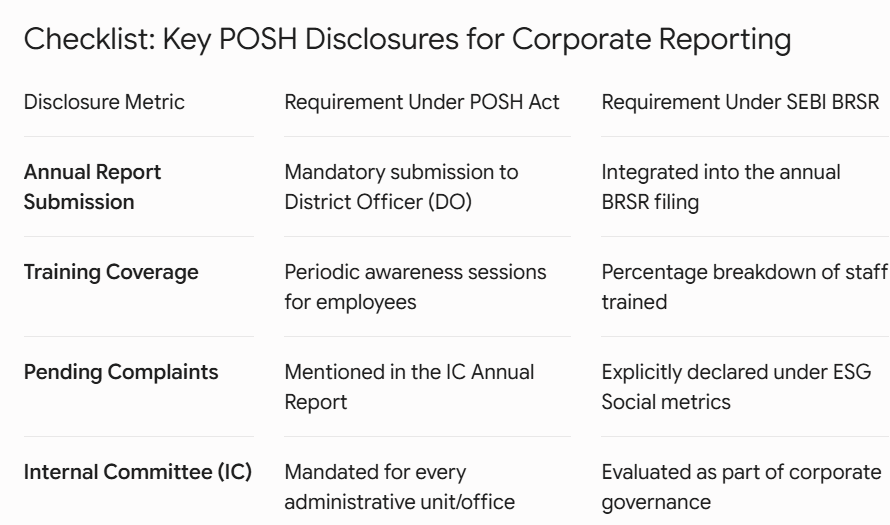
When filing for FY 2024–25, organizations must disclose explicit statistics concerning workplace sexual harassment complaints:
- Complaints Filed: Total number of sexual harassment complaints received during the financial year.
- Complaints Pending: Number of complaints pending resolution at the close of the financial year.
- Turnaround & Resolution: Proportion of complaints resolved within the statutory 90-day inquiry window.
- Preventative Action: Details on corrective measures taken by the organization post-investigation.
- Awareness & Training: Percentage of total workforce (permanent employees, temporary workers, and contractors) covered under POSH awareness workshops.
Why Integrated POSH and BRSR Reporting Matters
Integrating POSH compliance into BRSR filings moves legal adherence into the spotlight of investor scrutiny and brand reputation:
- Investor Confidence: Institutional investors evaluate ESG metrics heavily before allocating capital. Transparent POSH metrics signify strong internal governance.
- Audit Trail & Integrity: Misalignment between statutory POSH reports submitted to local authorities and data published in the BRSR can lead to regulatory red flags.
- Workplace Culture: Demonstrating a zero-tolerance policy backed by swift redressal turnaround builds long-term employer brand equity.
Best Practices for HR & Legal Teams for FY 2024–25
- Reconcile IC Records Early: Ensure the Internal Committee’s annual metrics align precisely with the numbers submitted in the BRSR framework.
- Track Training Coverage Data: Document attendance numbers for both permanent employees and contractual staff during POSH awareness sessions.
- Monitor Inquiry Timelines: Ensure pending complaints do not exceed the statutory 90-day inquiry window to avoid negative disclosure metrics.
Key Takeaway for Listed Entities
POSH compliance is no longer just an internal HR matter—it is a public ESG metric. Preparing early for FY 2024–25 ensures your corporate disclosures reflect a safe, compliant, and legally resilient organization.
Avoid ESG Red Flags: Reconcile Your POSH Metrics with Poshaw LLP
A mismatch between your IC annual report and your public BRSR disclosure can invite regulatory scrutiny and damage institutional investor trust. Are your internal records audit-ready for FY 2024–25?
Poshaw LLP provides end-to-end support for listed entities and corporate leadership. From auditing inquiry timelines to delivering certified workforce training sessions that boost your ESG compliance metrics, we ensure your filings are 100% accurate and legal-proof.
Ensure your corporate governance standards stand up to investor scrutiny. Reach out to our ESG & POSH compliance specialists today to review your reporting data before filing season begins.
Connect with our Compliance Team:
- Call Us Directly: +91 9773831359 | +91 9999415757
- Email: Info@poshaw.in
- Head Office: A2/56 Hastsal Road, Uttam Nagar, New Delhi - 110059